
Garner Health
Garner HealthMedical
4.663.00 Reviews
- Version
- 11.24.0
- Installs
- 100.00K
- Age Rating
- Everyone
Screenshots
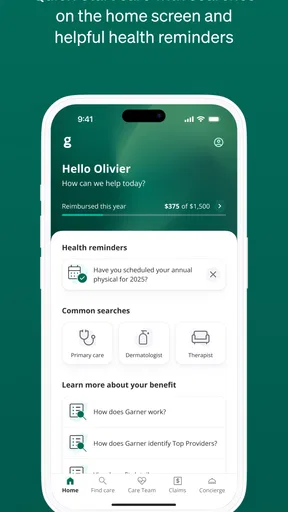
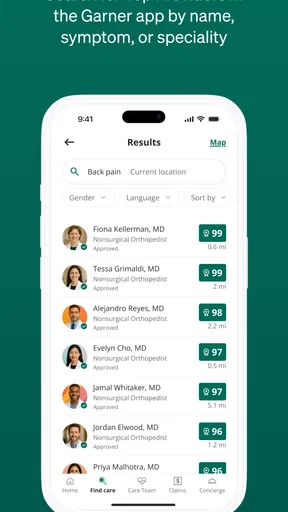
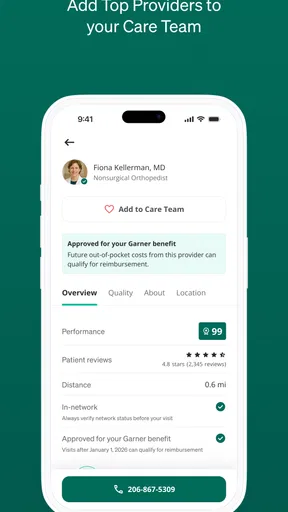
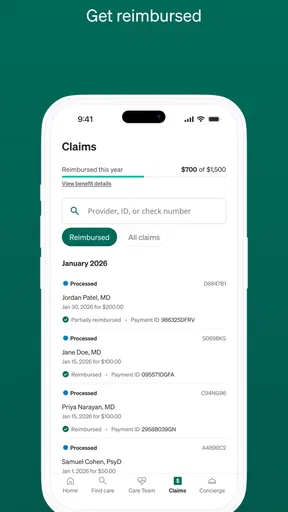
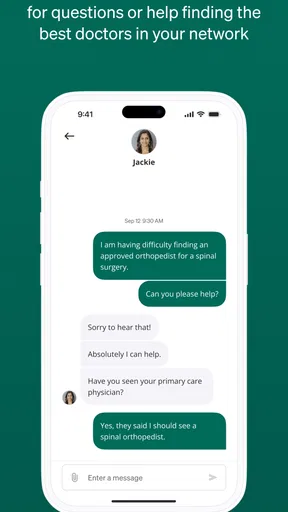
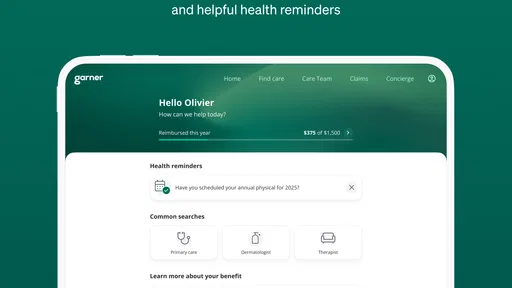
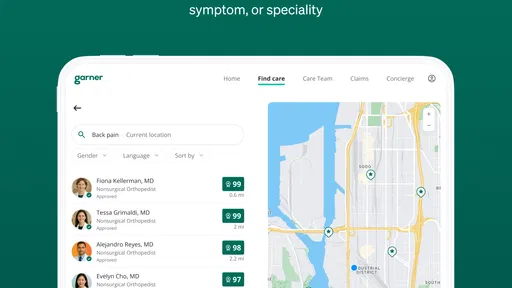
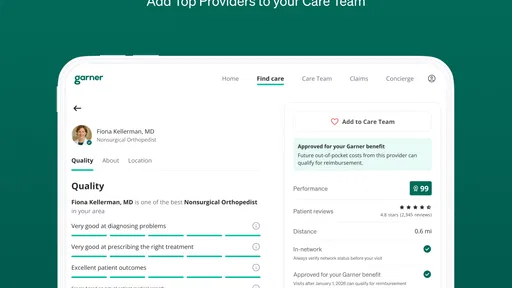
Our Review of Garner Health
 Analysis by Appyee
Choosing a doctor is rarely a one-time decision. It can affect how quickly a problem is identified, how comfortable you feel asking questions, and how much you spend over time. Garner Health approaches that decision from a practical angle: it is a medical app from Garner Health that is designed to help eligible users get reimbursed when they choose higher-quality doctors. I found the idea more useful than a typical provider directory because it connects doctor selection with a possible financial benefit, rather than treating search as the end of the process.
The app is free, aimed at everyone, and sits in the medical category. Its appeal is strongest for people who already have access to its reimbursement arrangement through their health coverage or employer. For those users, it can become part of the routine before booking care. For everyone else, the value is less immediate, because a doctor-finding tool is only truly helpful when its recommendations and reimbursement rules apply to your situation.
What Garner Health feels like during the first week
My first impression is that Garner Health makes the doctor-search problem feel more concrete. Instead of starting with a long list of names and leaving me to guess which ones are worth considering, the app’s purpose is tied to quality and reimbursement. That gives the search a clearer question: which available doctor can provide appropriate care while also fitting the program’s rules?
That distinction matters. Ordinary search tools often make convenience the main filter. They may help locate a nearby office, show basic specialties, or surface patient feedback, but they do not necessarily help me understand whether choosing one clinician over another could improve my reimbursement outcome. Garner Health is more focused on the decision behind the appointment, not just the appointment’s address.
The first-week appeal comes from that change in mindset. I would be more likely to open it before scheduling a specialist, arranging a routine visit, or helping a family member find care. The app is not something I would casually browse every day. Its usefulness appears at specific moments when a medical choice has to be made and the consequences of that choice may continue after the visit.
A realistic example would be someone who receives a recommendation for two specialists. One office is familiar because it appears first in a general search, while the other may better fit Garner Health’s quality-based approach. Rather than choosing only by habit, the user can check the available option through the app before committing. That extra step could be worthwhile when the appointment is important, the care may continue for months, or reimbursement would make a meaningful difference.
I also appreciate that the app’s central promise is easier to understand than many healthcare products. It is not trying to replace a doctor, diagnose symptoms, or act as an emergency service. It belongs earlier in the process, when I am deciding where to receive care. That narrower purpose makes it easier to judge: if it helps me make a better provider choice and receive the reimbursement I qualify for, it has done something valuable.
Still, the first week is not completely frictionless. The benefit depends on personal circumstances, including whether the user is covered by a participating arrangement and whether the selected care fits the relevant requirements. That means I would not treat a doctor appearing in a search as an automatic guarantee of payment. I would read the details attached to the recommendation and keep any reimbursement instructions available before the appointment.
This is one of the most important practical habits with Garner Health: use it before the decision, not after the bill arrives. A person who books care independently and only later opens the app may have fewer options than someone who checks first. The app’s recurring value therefore depends on timing. It rewards a short planning pause before care, rather than serving as a rescue tool for a claim that has already been submitted.
Garner Health has also built enough trust with its audience to earn a 4.7 average from around 346 ratings, while its reach has passed 50 thousand installs. Those figures suggest that the concept resonates with many users, but they do not remove the need to check personal eligibility. In healthcare, a positive general impression is helpful; the details of an individual plan still matter more.
Who benefits most from the initial setup
I see the strongest fit for people who expect to make several healthcare decisions during the year. Someone managing a chronic condition may need to compare specialists, coordinate follow-up care, and think carefully about quality rather than simply taking the first available appointment. A parent arranging care for several family members could also appreciate having a dedicated place to begin the search, especially when a provider choice involves more than convenience.
The app may be less compelling for a person who already has a trusted doctor, rarely changes providers, or only wants the fastest nearby appointment. If the user’s priority is immediate availability and the reimbursement aspect does not apply, a standard insurer directory or local search service may be quicker. Garner Health earns its place when the quality-and-reimbursement connection is relevant, not merely because it is another medical app.
That is a useful early trade-off. The app does not need to be opened constantly to be worthwhile. It needs to be opened at the right moments. In my view, that makes the first week more about learning when to use it than about building a daily habit.
Why the value can continue from month to month
The lasting case for Garner Health is not novelty. It is repetition across real healthcare decisions. A single successful search can be helpful, but the stronger reason to keep the app installed is that provider selection happens again whenever a new specialist, second opinion, follow-up service, or family appointment enters the picture.
Month-to-month value depends on whether I remember to make the app part of my planning routine. Before accepting a referral, I would check Garner Health first. Before assuming that the doctor recommended by a friend is the best financial choice for my coverage, I would compare the available path in the app. Before scheduling care for someone else in my household, I would confirm that the provider and reimbursement process fit the applicable arrangement.
This workflow is more useful than treating the app as a replacement for every other healthcare resource. I would still use my insurer’s information for coverage questions, the medical office for appointment availability, and a clinician for medical advice. Garner Health works as a decision layer between those steps. It can help me choose where to start, while the other sources answer questions about benefits, scheduling, and treatment.
That separation prevents a common mistake: assuming that a quality recommendation answers every practical question. It does not necessarily tell me whether the office has an appointment when I need it, whether a particular service requires authorization, or whether a specific procedure is covered under my plan. I would use the app to narrow the provider choice, then confirm the operational details directly through the appropriate channel.
One non-obvious strength is that the reimbursement angle may encourage better planning even when the financial amount is not the only concern. Knowing that the provider decision could affect what I receive back gives me a reason to pause before choosing based on convenience alone. That pause can be especially valuable for expensive or recurring care, where a small difference in the initial choice may matter repeatedly.
Another useful approach is to keep a simple personal record of why a provider was selected. I would note the doctor’s specialty, the reason for the visit, and any reimbursement instructions shown during the process. This is not a feature I would assume the app manages for me; it is a practical companion habit that reduces confusion when several appointments and claims overlap. Garner Health becomes more effective when I treat its recommendation as the beginning of an organized workflow rather than the entire workflow.
The app’s current release is version 11.7.0, and it supports devices running Android 7.0 or later. That makes it accessible to people who do not replace their phone frequently. Compatibility is not the same as long-term usefulness, of course, but it lowers one possible barrier for users with older Android hardware.
Its free price also makes keeping it available relatively easy to justify. I do not need to decide whether I will use it every week before installing it. I can leave it ready for the next provider decision and return when a healthcare need appears. That is a better fit for this type of tool than a subscription-style habit would be.
Where recurring value starts to weaken
The monthly benefit can fade if my healthcare needs are simple and stable. Someone who sees the same primary-care doctor, has no upcoming referrals, and does not expect a provider change may have little reason to open the app between appointments. In that situation, the app can remain useful in the background, but it may not earn a prominent place on the home screen.
There is also a difference between finding a recommended doctor and being able to use that doctor. Location, appointment timing, specialty availability, and personal comfort still matter. A quality-based suggestion is not automatically the right choice if the office is impractical, the wait is too long, or the clinician does not meet the patient’s communication needs. I would use Garner Health as a strong input, not as permission to ignore those human factors.
For users who want a broad medical companion with symptom tracking, medication reminders, telehealth, or direct clinical messaging, this is probably not the right category of app. Garner Health’s value is narrower and more financial-decision oriented. Choosing it means accepting that focus rather than expecting a complete digital health system.
Maintenance, friction, and the reasons users may get tired
The maintenance burden is moderate rather than constant. I would not expect to open Garner Health daily, but I would need to remember it before making provider choices. That memory requirement is the main maintenance task. If I forget the app until after scheduling, its most important advantage may arrive too late to influence the decision.
Healthcare information also changes in ways that make careful checking necessary. A provider’s availability can shift, a referral can have conditions attached, and reimbursement can depend on the specific care received. I would avoid saving an old assumption and reusing it automatically for every appointment. The safer habit is to revisit the relevant details each time the situation changes.
That may feel repetitive, especially for someone already dealing with insurance paperwork. The app’s promise is attractive because it could simplify a complicated choice, but it cannot remove every administrative step. I would still expect to keep appointment records, understand what my plan requires, and follow any instructions connected with reimbursement. Garner Health can reduce uncertainty at the provider-selection stage, but it does not turn healthcare administration into a one-tap process.
The biggest source of fatigue is the gap between a recommendation and a completed financial result. Users may open the app expecting an immediate, fully explained answer about what they will receive back. In practice, reimbursement is the kind of benefit that deserves careful reading. If the process involves additional documentation or timing requirements, overlooking them could undermine the value of choosing through the app.
My practical tip is to use a three-part check before booking: confirm that the doctor fits the medical need, confirm that the office is workable for the patient, and review the reimbursement steps while the choice is still reversible. This prevents the app from becoming a single-factor decision tool. It also makes clear when a different option is better: if the recommended provider cannot see the patient soon enough or is too difficult to reach, timely appropriate care may deserve priority over a possible financial advantage.
Another source of fatigue is repeated searching for relatives. A person managing care for a partner, child, or older family member may need to switch between different needs and coverage situations. I would prepare the information required for each person before starting a search, rather than assuming that one result applies to everyone. The app’s usefulness can extend to family planning, but only when the user stays attentive to whose coverage and care are being considered.
Privacy and trust also deserve a realistic place in the decision. This is a medical app, so I would be deliberate about the information I enter and would read the app’s own explanations of how the service works before relying on it for sensitive decisions. I would not use it as a substitute for urgent medical help, and I would contact a qualified professional when the question is about symptoms or treatment rather than provider selection.
The developer, Garner Health, has kept the product’s identity focused enough that I can understand its role quickly. That is good for reducing feature clutter, but it also means the app will not satisfy people looking for a large collection of unrelated health tools. The trade-off is clarity: fewer reasons to open it, but a clearer reason when the right situation appears.
How it compares with the usual alternatives
An insurer directory is the most obvious alternative. It is usually the place I would go to verify network participation and basic benefit information, so it remains important. Garner Health differs by putting greater emphasis on the quality of the doctor and the possibility of reimbursement connected with that choice. I would use both when the decision matters: Garner Health to guide the provider search, and the insurer’s resources to confirm coverage details.
General search engines and map-based listings are faster for finding nearby offices, but they can leave the hardest question unanswered: which provider is the better fit for care and the reimbursement program? They are useful for practical checks such as distance and opening times, yet they are not a complete replacement for Garner Health’s specific purpose.
Personal recommendations are valuable because friends and relatives can describe communication style and office experience. However, their coverage and medical needs may differ from mine. I would treat a personal recommendation as a lead, then use Garner Health and my coverage information to decide whether it makes sense in my own situation.
Finally, a primary-care doctor or specialist may offer the most medically informed referral. I would not disregard that advice simply because the app suggests another option. The best workflow is collaborative: use clinical guidance to understand the kind of care needed, use Garner Health to investigate the provider choice, and confirm logistics before booking.
Does it earn lasting space on the phone?
After the initial appeal fades, I think Garner Health can earn lasting space for people whose healthcare choices are frequent, expensive, or difficult to navigate. Its free access lowers the cost of keeping it available, and its purpose is distinct enough to remember when a referral or specialist search appears. The app’s 4.7 average across around 346 ratings reinforces that many users find the concept worthwhile, though personal eligibility remains the deciding factor.
I would not recommend it as a universal replacement for an insurer app, a doctor, or an emergency service. Someone who wants appointment booking above all else, needs symptom advice, or has no connection to the reimbursement program may find a different tool more immediately useful. Garner Health is strongest when the user is willing to plan one step ahead and compare provider choices instead of accepting the first convenient name.
My long-term verdict is positive, with one condition: make it part of a repeatable pre-appointment routine. Open it before selecting a doctor, check the recommendation against practical needs, review the reimbursement instructions, and then verify coverage and scheduling through the proper channels. Used that way, it offers recurring value without demanding daily attention. It is not a flashy health companion, and that is part of its appeal. Its lasting strength is helping turn provider selection into a more deliberate decision.
For me, that is enough reason to keep it installed. I would not open it out of habit every morning, but I would want it ready when a new medical decision arrives. That is a realistic kind of longevity: not constant engagement, but dependable usefulness at the moments when choosing the right doctor matters most.
Privacy and Permissions
See what permissions an app requests and how it handles your data.
- Location
- approximate location (network-based), precise location (GPS and network-based)
- Photos/Media/Files
- read the contents of your USB storage, modify or delete the contents of your USB storage
- Storage
- read the contents of your USB storage, modify or delete the contents of your USB storage
- Camera
- take pictures and videos
- Microphone
- record audio
- Wi-Fi connection information
- view Wi-Fi connections
- Other
- view network connections, change network connectivity, full network access, run at startup, draw over other apps, control vibration, prevent device from sleeping
Verdict
Strengths of Garner Health
- Personalized health guidance based on your health profile
- Helps compare doctors using quality and cost information
- Can simplify finding in-network healthcare providers
- Offers recommendations tailored to your insurance coverage
- Useful for planning preventive care and routine appointments
Limitations of Garner Health
- Availability and features may vary by employer or insurance plan
- Provider ratings and data may not cover every local specialist
- Some recommendations require sharing sensitive health information
- Costs shown may differ from the final bill or insurance processing
- Less useful for users outside supported U.S. healthcare networks
Similar Picks in This Category
View All
WebMD: Symptom Checker
WebMD, LLC4.1

Microphone Amplifier
DOSA Apps4.2

Anatomy Learning - 3D Anatomy
3D Medical OU4.5

Period Tracker and Calendar
SimpleInnovation4.9

GoodRx: Prescription Coupons
GoodRx4.8

CVS Health
CVS Pharmacy4.5
Frequently Asked Questions
What is Garner Health, and how does it work?
Garner Health is a healthcare navigation app designed to help users find high-quality doctors and medical providers. It typically uses provider-quality information, treatment outcomes, and user-specific healthcare needs to recommend clinicians. Depending on your employer or health plan, the app may also help with appointments, care guidance, medical records, and benefits. Available features can vary by membership and location.
Is Garner Health free to download and use?
The Garner Health app may be free to download, but access to its services usually depends on whether your employer, insurance plan, or healthcare program provides Garner as a benefit. Some users may receive navigation support or provider recommendations at no direct cost, while eligibility and covered services can differ. Check your account or benefits information before relying on the app.
Can Garner Health help me find a doctor or specialist?
Yes, one of Garner Health’s main purposes is helping users identify doctors and specialists who may provide high-quality care. You can generally search according to your medical need, location, and insurance details. The app may offer recommendations rather than guaranteeing availability, so it is still important to confirm that the provider accepts your plan and is currently taking new patients.
Does Garner Health make medical decisions or replace a doctor?
No. Garner Health is intended to support healthcare decisions by offering provider information, navigation assistance, and access to relevant resources. It does not replace a licensed physician, diagnosis, emergency service, or personalized medical evaluation. Do not use the app for urgent symptoms. Contact emergency services or a qualified healthcare professional when immediate medical attention is needed.
What personal and health information does Garner Health require?
To provide personalized recommendations, Garner Health may request information such as your name, location, insurance or benefits details, healthcare preferences, and possibly medical-related information. Before creating an account, review the app’s privacy policy and permissions carefully. Only provide information through official channels, and remember that available data practices may vary according to your employer or health plan.
